One nutrient, two ways to die: new insights into small cell lung cancer
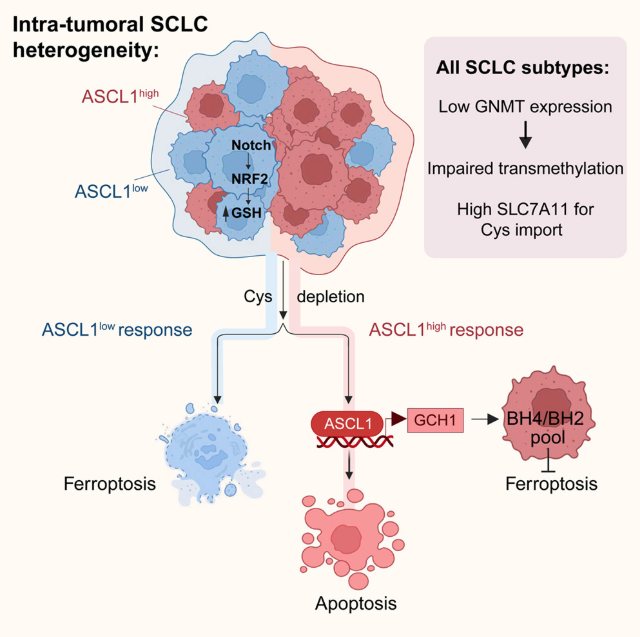
Small cell lung cancer (SCLC) is not one uniform tumor. It consists of different cell states, which is one reason it is so difficult to treat. A new study led by Silvia von Karstedt’s lab, together with Julien Sage’s lab at Stanford University, shows how this diversity can be turned against the tumor.
The team found that all SCLC cell states depend on the amino acid cysteine but die in different ways when it is withdrawn: ASCL1-low cells undergo ferroptosis, while ASCL1-high cells die by apoptosis. They also identified a molecular mechanism that explains why ASCL1-high tumor cells resist ferroptosis, and showed that it can be exploited therapeutically. In the long term, this could open up new treatment strategies for this particularly aggressive cancer.
Congratulations to co-first authors Christina Bebber and Jun W. Kim and all co-authors on this international collaboration. The work was supported in part by the Deutsche Forschungsgemeinschaft (DFG) – German Research Foundation through SFB 1399.
Original publication:Read the full article in Cell